What's new:
August 2025: New Training Course
FRMCS – Details of the Core Network
Course Description
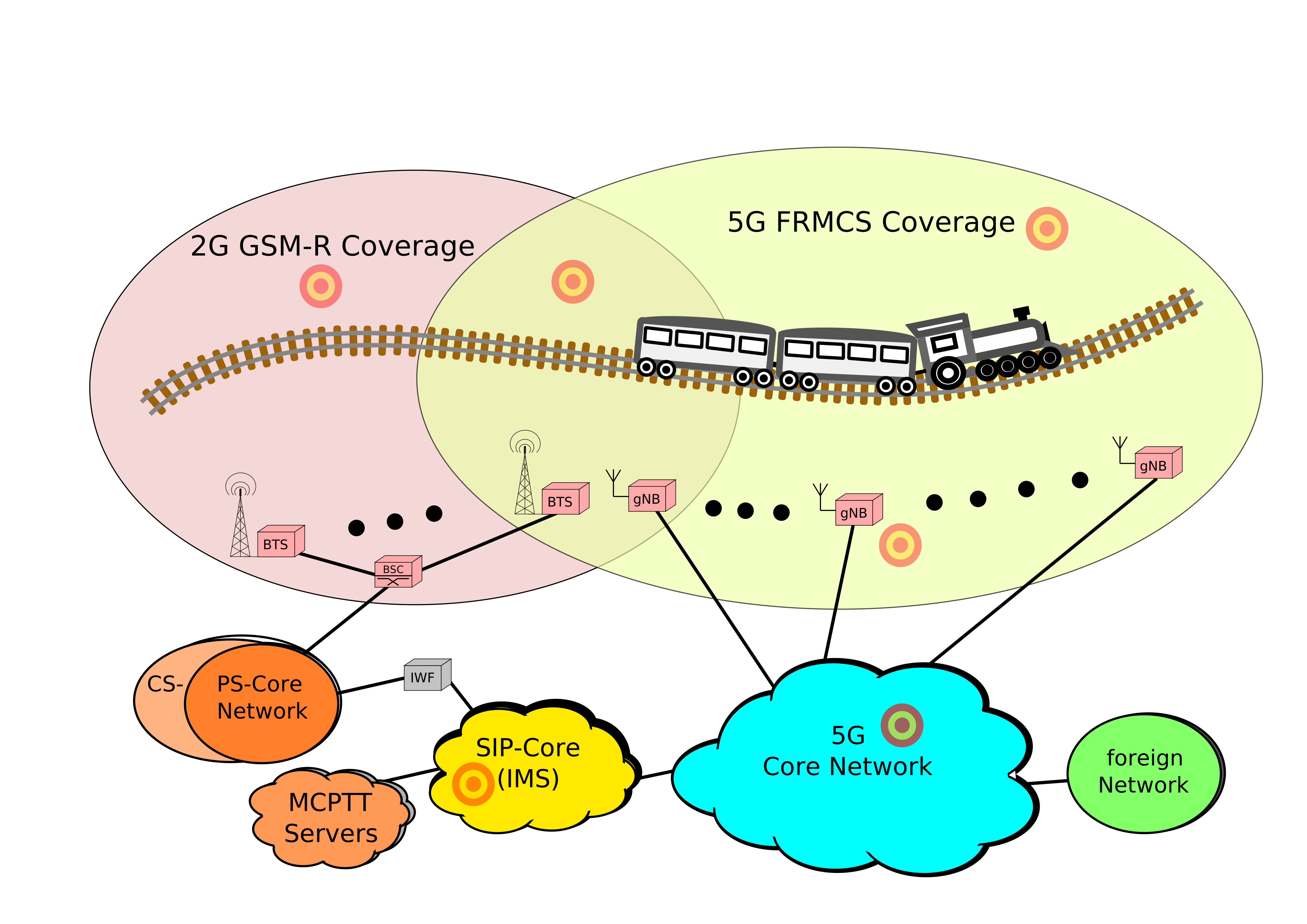
This course addresses the needs of everybody who requires a detailed understanding of the cloudified core network which shall be deployed in the FRMCS environment.
We also cover the FRMCS-specific interaction with the IMS in order to provide for mission-critical services like PTT.
By using Open5GS we expose the students to a real-life evironment to accompany the theoretical parts.
Another highlight of the class is how to dimension a cloudified core for the FRMCS. The understanding of this objective is particularly important for railways operators as their requirements are entirely different from those of telecom network operators.
We integrated several hands-on parts as for example the setup of Open5GS in a Kubernetes environment or the analysis of a SIP-based PTT-call setup procedure.
Course Duration
- 2 days / 4 x ½ days
Prerequisites
- The students should possess basic understanding of cellular networking, IP and related protocols like SIP/SDP.
- We also assume that the students had prior exposure to GSM-R and its specifics.
- Basic understanding of network virtualization, containerization and related administration is a big plus.
Some of your questions that will be answered:
- What are the tasks and functions of the different network functions in the 5GC like AMF, SMF or UDM? What is specific for the FRMCS?
- What are microservices and how do they relate to the aforementioned network functions?
- How do the offered services change from GSM-R to FRMCS?
- What changes procedurally from GSM-R to FRMCS wrt registration to the network, authentication, call setup and mission-critical services?
- To which extent can we use the Open5GS for testing and integration of Kubernetes and cloudification prior to the real implementation of our FRMCS?
- How to dimension a 5GC for our FRMCS properly? We need to consider specific requirements like high availability, mission-critical use cases and others.
- Which role does Kubernetes play in the operation of our FRMCS core network?
- How can we get a real feeling for the operation of a cloudified network?
Course Target
- The student obtains a thorough understanding about the FRMCS in general and its cloudified core in particular.
- After the class, students may ask educated questions related to K8s, dimensioning of a cloudified 5GC for the FRMCS.
- Students understand how mission-critical services are setup through IMS and the cloudified 5GC.
- The student is enabled to identify typical operational issues in the cloudifued 5GC for FRMCS.
Please check here for a detailed view on the content.
Please send an email to inacon@inacon.de if you would like further information.
December 2024: New Training Course
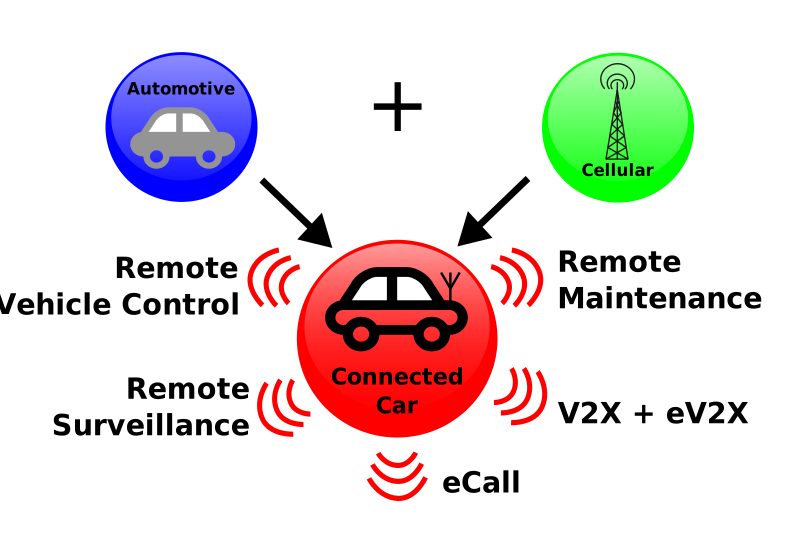
Automotive + Cellular = Connected Car
Course Description
In recent years, vehicles on the street have become increasingly dependent on cellular connectivity for various objectives.
This course addresses the related needs, particularly of car manufacturers around the globe plus their suppliers to cope with the unavoidable questions and constraints.
We start with a -not to deep- description of 2G to 5G, their technology, limitations and provided services. In this chapter, we also outline a basic understanding of the related network architectures.
We continue by depicting the car-internal infrastructure, namely the TCU with eSIM, the GNSS and the CAN-bus controller and their typical interworking. This will become important at a later stage when typical issues and problems from the field need to be analyzed.
We describe the meaning of important identifiers like IMSI, TMSI, SUPI and SUCI.
This chapter concludes with a description of the tasks and functions of CMP’s (connectivity management platforms), FMS’s (fleet management systems), MNO’s (mobile network operators) and their interaction with the connected car.
The second chapter deals with all aspects of cellular operation and how it affects the connected car. That refers to basic cell selection and reselection plus registration to the core network as homer and as roamer, which is of particular interest to the car industry.
We depict the meaning of important AT-commands to make transparent how the TCU controls its internal modem.
We highlight the meaning of the SIM-profile for the identification and authentication process.
Students are introduced to the process of IP-address allocation to the TCU inside the connected car. We also highlight typical problems in the field like NAT-issues and timely restrictions.
Very important is also a basic understanding of the interworking between the TCU and another network component, the IMS (IP multimedia subsystem) which is based on SIP/SDP-protocols and which is crucial, among others, for NGeCall.
This chapter concludes with an introduction to basic cellular procedures like CSFB and SRVCC and their meaning for the connected car.
The third chapter is fully dedicated to the SIM/eSIM and its handling with strong focus on the eSIM. We illustrate the structure of a SIM-profile with related identities (e.g. eUICC-ID) and depict an example, the GSMA eUICC-Test-Profile.
We also highlight the differences of IoT-specific eSIM-profile handling between the GSMA standards SGP.02 (legacy) and SGP.31/SGP.32 (new). This contains a description of tasks and functions of eUICC, SM-DS, SM-SR, SM-DP, SM-DP+ and eIM.
The final chapter is dedicated to the daily operation of the connected car. We depict the different options how SMS (short messages) may reach the TCU and how they serve to wake-up a TCU from half-sleep mode.
We continue with a short and practical introduction to MQTT and its meaning for the interworking between the network, the MQTT-broker (e.g. Mosquitto) and the connected car.
We illustrate the process how a car owner uses an App on their smartphone to switch on the air condition in the connected car or controls other car-internal systems.
Of course, we also highlight the process and differences of eCall and NGeCall and which information is transmitted as part of MSD (minimum set of data).
Course Duration
- 2.5 days
Prerequisites
- The student should possess basic understanding of cellular networking, IP and other protocols.
- Prior exposure to technical design and testing for automotive and/or networking is beneficial.
Some of your questions that will be answered:
- What does cellular refer to, in the first place?
- What are the most important technical enhancements from 2G to 5G?
- How do the offered services change from 2G to 5G?
- What is an IMSI?
- Why do we use eSIM and what are differences to SIM?
- How does the TCU in a car select the serving cellular network?
- How does a TCU in a car obtain an IP-address?
- What does OTA mean and which options exist?
- What is the content of a SIM-profile?
- Who provides SIM-profiles for an eSIM?
- Why and how can we swap the profile on an eSIM?
- How does eCall work and what changes with NGeCall? What can go wrong?
- Which constraints does energy saving impose on the connected car?
- How does the connected car interwork with MQTT-brokers?
Course Target
- The student obtains a thorough understanding about cellular operation in the connected car environment.
- After the class, students may ask educated questions related to connected car.
- The student is enabled to identify typical operational issues in the interworking between the connected car and its environment.
Please check here for a detailed view on the content.
Please send an email to inacon@inacon.de if you would like further information.
May 2024: New Training Course
5G NR: Deep Dive into Rel 17 & Outlook to Rel 18
Course Description
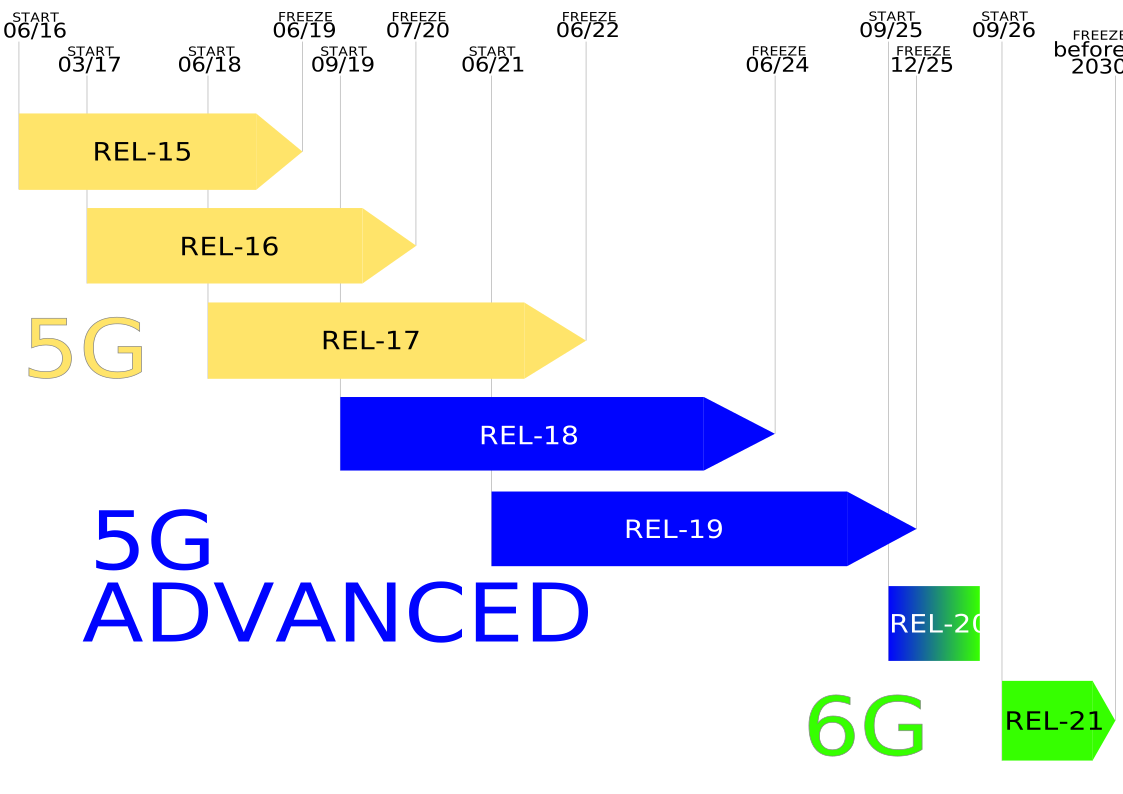
This course focuses on the evolution of 5G from 3GPP Rel 15/16 towards Release 17 with a quite detailed outlook towards Release 18. We also depict the envisaged timeline of 3GPP towards 6G. After a review of 5G NR with Release 15 and a focus on Release 16 features, the course initially provides an overview of all relevant Release 17 features like NTN, RedCap, CE, 1024-QAM, MIMO-enhancements and many others. The following three chapters provide deep dives into the most important new features of Release 17, namely NTN, RedCap and CE. Please refer to the detailed description in the table of content. The final chapter is dedicated to Release 18, which is the first 5G Advanced Release according to 3GPP. Focus here is on network energy savings, eRedCap, MIMO evolution and SBFD (TDD-evolution).
Course Duration
- 2 days
Prerequisites
- The student must possess detailed knowledge about the PHY and protocol stack in NR.
- Detailed knowledge of general RF-issues like link budget, receiver sensitivity is strongly recommended.
Some of your questions that will be answered:
- How does NR over NTN (non-terrestrial networks) operate?
- What is the difference between transparent and regenerative payload?
- Why NTN may make sense after all failed attempts to add satellite services to cellular in the past three decades?
- What are the impacts of NTN on latency, mobility and services?
- How does cell selection work in NTN?
- What are characteristics of RedCap-devices?
- What are the implications of operating RedCap-devices?
- Why do we need special BWP for RedCap-devices?
- Which special operation do RedCap-devices need to obey?
- How does coverage enhancement (CE) work in Release 17?
- What is TBoMS and how is it parametrized?
- Which performance improvements can be expected from CE?
- Which implications do network energy savings (NES) have on the UE?
- How and where can SBFD be deployed and how does it work?
Course Target
- The student is enabled to state the Release 17 and Release 18 specific enhancements of NR.
- The student understands in detail the implications of NTN, RedCap, NES and CE.
Please check here for a detailed view on the content.
Please send an email to inacon@inacon.de if you would like further information.
February 2024: New Training Course
AI, ML & Deep Learning in the Evolution of 5G and 6G
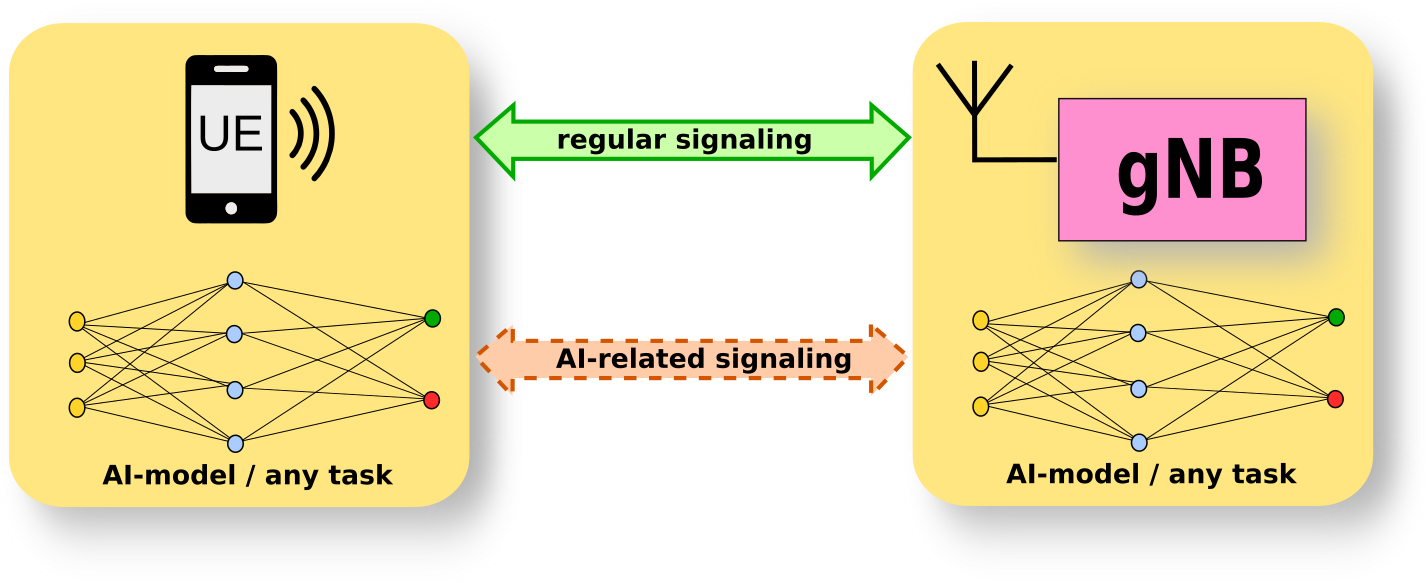
This new training course is a "need to have" for all technical staff in the cellular industry who want to understand how Artificial Intelligence (AI) will re-shape their working environment within the next decade.
- The first chapter addresses two needs:
- De-mystification and first classification of AI. For example, we ask a few questions to ChatGPT and identify the limitations of this fascinating LLM (Large Language Model).
- To present the study items (SI) that 3GPP picked in 5G Advanced with Rel 18 and 19 to investigate, if, how, and to which degree different AI-models can improve cellular processes and operation.
- Please note that this part is only intended as an overview to pave the way for the following chapters that focus on generic AI.
- The second chapter is dedicated to AI-terminology and underlying technology. We explain in detail the operation of neurons and their different activation functions. We also present important AI-architectures like CNN (Convolutional Neuronal Network), which is particularly interesting for the cellular environment.
- We also explain how NN's (Neuronal Networks) are trained with focus on supervised and unsupervised learning.
- In a hands-on portion we show examples for convolution and max pooling operations.
- In the next chapter we can observe AI at work: Using the MNIST-database we perform a live training of a configurable neuronal network to perform handwriting recognition on 60,000 samples of handwritten digits.
- Live configuration relates to number of epochs, deployed activation function, number of hidden layers and neurons per layer etc.
- After this command line experience, it is time for a deeper dive into the AI-approach of 3GPP with Rel 18 and 19. In this chapter we introduce the underlying AI-related technology of these different study items and present the simulation results. As one example, we catch the technical details about and behind CSI-compression and prediction through AI and relate these details back to the generic AI that we already introduced.
- We also highlight 3GPP-specifics like life cycle management and which network elements may host which AI-specific functions like model storage, management etc.
- The final chapter looks beyond 5G-Advanced and towards 6G: What is an AI-native radio interface and how does it alter the signal processing chain in transmit and receive direction?
- We take a critical look behind the simulation results and the used channel models to better understand the practical relevance of such ubiquitous AI in the PHY-layer of cellular equipment.
- The course can be provided onsite and online with preference on the online / webinar option.
Some of your questions that will be answered during this course:
- In which areas of cellular will AI most likely be deployed?
- What are the simulation results of the various 3GPP study items on AI?
- What is the difference between neuron and perceptron?
- Do we really require standardization of AI in cellular?
- Under which circumstances do we require supervised learning and when can we use unsupervised learning?
- How can AI improve the UL-coverage through non-linearity compensation of the UE power amplifier?
- What are the specifics of an AI-native radio interface which is currently investigated for 6G?
- How does it work?
- In which respect can the ORAN RIC's and their xApps and rApps leverage network automation and self-organized networking also in proprietary environments?
Please check here for a detailed view on the content.
Please send an email to inacon@inacon.de if you would like further information.
July 2023: New Training Course
5GC-Signaling & Protocol Analysis
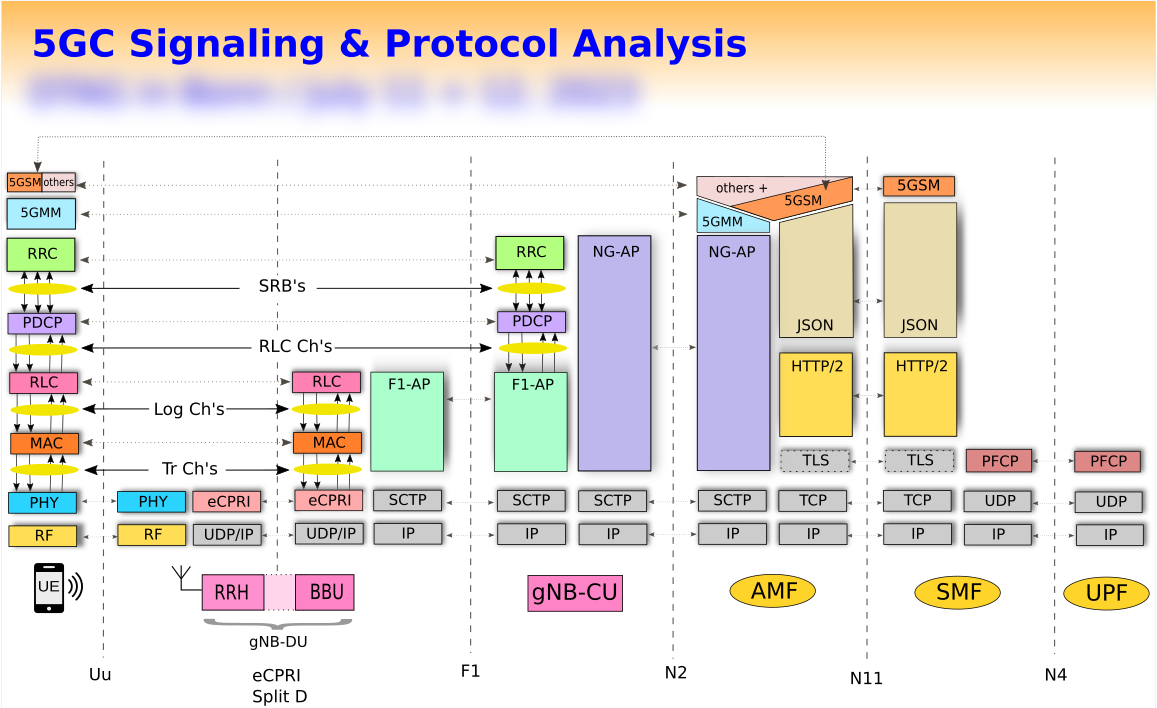
Our latest course has been designed to meet the needs of technical engineering staff who require deep inside of the protocols within and around the new cloudified 5G SA core network.
- The first chapter shall provide a warm up of the 5G network and its environment and services. Focus is on the different operating options, the differences between NSA and SA, CUPS and QoS in 5G.
- The second chapter reviews the service based architecture (SBA) in a cloudified environment (K8S) and makes students familiar with the details of RESTful communication among containers.
- Then we make a deep dive into the protocol details and operation of HTTP/2. This part is loaded with practical examples and real-life logfile analysis for the students.
- We also dedicate quite some time on exercising with publicly available YAML-browsers to evaluate HTTP/2- and JSON-context within the SBA.
- The following chapters are dedicated to the N1-, N2- and N3-interfaces towards the RAN with focus on NG-AP, GTP-U and its extension headers and of course NAS-signaling protocols 5GMM and 5GSM.
- We provide a deep insight into the related procedures, esp. 5GMM Registration and 5GSM PDU-Session Establishment but also handover procedures. In this context we analyze both, the 3GPP-based scenarios and real-life logfiles.
- Special focus is on 5G-specific enhancements like network slicing, NSSAI, SUPI/SUCI and 5G-AKA authentication.
- The course can be provided onsite and online with preference on online / webinar option.
Some of your questions that will be answered during this course:
- How can I relate messages within the 5GC to each other that belong to the same transaction?
- In the same context: How do I interpret HTPP/2-message parameters like method, stream identifier and flag settings?
- Which information do the pseudo-headers yield?
- Where do I find and how do I interpret QFI-information inside GTP-U-frames?
- How do YAML-browsers help me during my HTTP/2- JSON-related trouble shooting and logfile analysis?
- Which settings do I need in Wireshark to receive proper output for HTTP/2?
- How do the different types of NSSAI's (requested, requested-mapped, configured, subscribed, allowed and rejected) relate to each other.
Please check here for a detailed view on the content.
Please send an email to inacon@inacon.de if you like further information.
April 2022: New Training Course
Open RAN: Architecture, Implementation & Operation
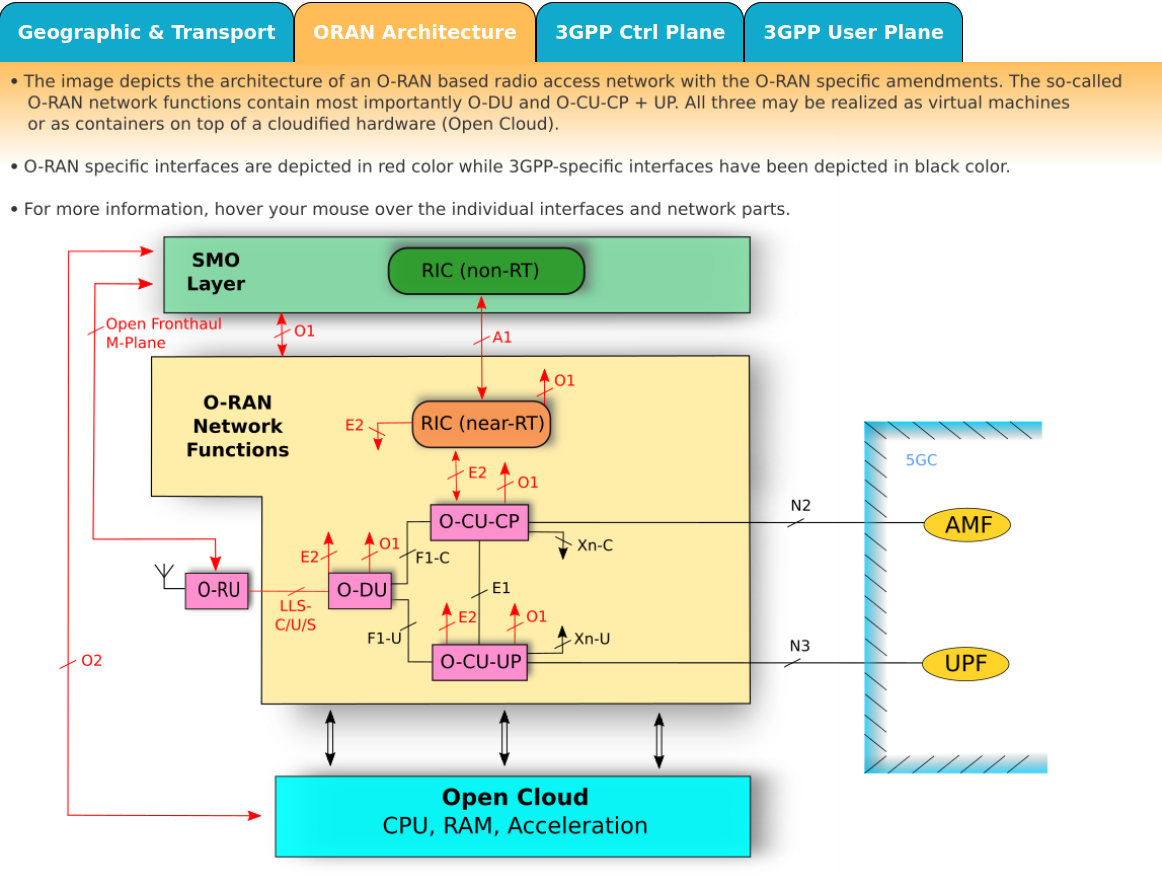
This new course has been tailored for the needs of technical engineering staff who require thorough and deep understanding of the fascinating Open RAN approach, which might change the way how radio access networks are built and how they are operated.
- Initially, we provide an introduction into the work and structure of the O-RAN alliance and an overview of the possible setup and configuration of O-RAN with different cloud types and locations.
- In this chapter we already dive deeper into the different functional split options with focus on PHY-split options 7.X. We take this opportunity to provide and exercise a formula to calculate the required fronthaul capacity (in Gbit/s) depending on different constraints like available radio bandwidth, deployed split option and number of antenna ports and layers on the radio side.
- The second part is dedicated to virtualization, starting with x86-based HW-virtualization but with focus on OS-virtualization and containers and pods. We practically exercise container handling and container orchestration with Kubernetes.
- We also dedicate quite some time on the detailed description of the different acceleration options like GPU's and FPGA's. In that part, we also analyze the pros and cons of inline and look-aside virtualization.
- The following chapter moves away from the plain RAN but focuses on the O-RAN specific RIC or RAN Intelligent Controller. We explain the split of the RIC into two parts, non-real time RIC and near-real time RIC and their most important parts: The rAPP's and the xAPP's. We present examples for both and provide an introduction into AI and ML and the principle operation of neural networks to enable the students to better understand the upcoming revolution in network operations with AI, enabled.
- The next chapter deals with O-RAN's system management and orchestration layer apart from the RIC's and illustrates how this SMO-layer manages the different parts of an open RAN network. We provide insights into system configuration through YANG and NETCONF.
- If there is enough time, we wrap everything up with political and technical conclusions about Open RAN and the most potential evolution of Open RAN into the future.
Some of your questions that will be answered during this course:
- What does O-RAN really mean and which level of openness is preferable under which circumstances?
- Why does O-RAN match so nicely the 5G-specific service enablers network slicing and mobile edge computing?
- How do the different functional split options of different organizations (e.g. 3GPP, SCF, eCPRI, O-RAN alliance) differ from each other?
- What are the differences between O-RU's with Cat-A and Cat-B? Why does the O-RAN alliance consider a Cat-C O-RU?
- What makes containers more appealing for virtualization than virtual machines? Which mix configurations to expect between the two approaches in the future?
- What are differences between the standardization of the 5GC and the O-RAN?
- What is ML (Machine Learning)? How does it work? How does it relate to AI (Artificial Intelligence) and DL (Deep Learning)?
- In which context does AI relate to xAPP's and rAPP's in the context of the RIC?
- How can an MNO onboard xAPP's from arbitrary sources?
- Where is the split in system management and orchestration between O-RAN's own SMO-layer and Kubernetes?
- How does O-RAN use NETCONF and YANG for the configuration of different parts of the network like O-DU's and alike?
Please check here for a detailed view on the content.
Please send an eMail to inacon@inacon.de if you like further information.
October 2021: New Training Course
Vo5G: Migration Path, Technology & Mobility
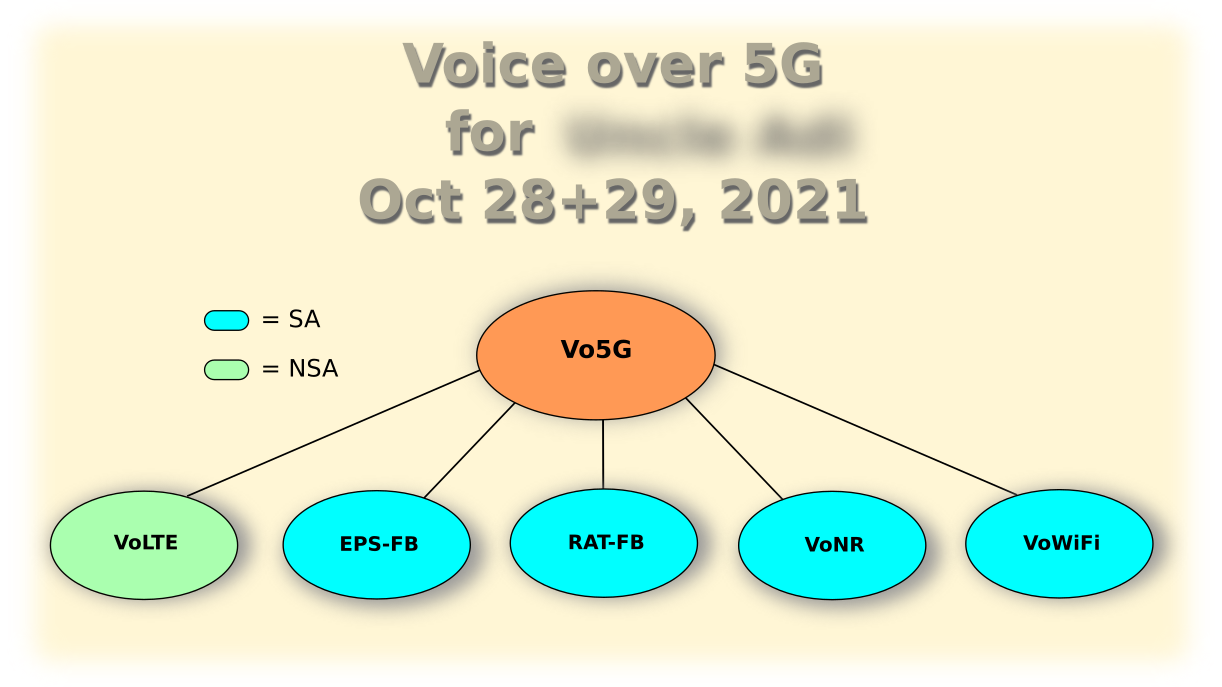
This course addresses the needs of technical engineering staff who require a detailed understanding of voice services over 5G-networks and the migration path from plain LTE or NSA towards true voice over 5G SA networks, called VoNR.
- We provide a detailed inside view into the different options how to migrate into that VoNR environment and why it is necessary for network operators to offer voice over their 5G networks.
- In that respect, we also highlight the various flags that the UE and the network need to exchange to indicate support for the various different variations of Vo5G.
- You will find a detailed description of scenarios like EPS-FB and RAT-FB in this course.
- Very important for many: These scenarios are real-life scenarios to provide you some deep insight view into the related signaling.
- Another chapter is dedicated to PHY-provisionings for VoNR, like PDSCH-/PUSCH-aggregation.
- Less focus because of little changes compared to VoLTE is on the SIP/SDP/RTP-layers of Vo5G but we have quite some background to address related questions or spend some time to clarify specific interests.
Some of your questions that will be answered during this course:
- Which enhancements does VoNR yield in comparison to VoLTE? (you might be surprised)
- How does the UE setup a PDU-session for IMS-services?
- Why do network operators initially implement EPS-FB rather than swiftly moving to VoNR?
- Why does EPS-FB typically use redirection rather than handover for the fallback into LTE?
- Which changes does the GSMA mandate for VoNR compared to VoLTE?
- Which codecs are used in VoNR for both, voice and video?
- Are there any adaptations for VoWiFi?
- Which implications apply for emergency services over 5G?
- May the IMS be used as platform together with SIP/SDP to discuss AR/VR-services?
Please check here for a detailed view on the content.
Please send an eMail to inacon@inacon.de if you like further information.
July 2021: INACON announces the availability of an exciting new self-paced video training about 5G-technology:
5G Update - 2021 & Beyond
This video course is structured into five chapters and enables a self-paced technology training experience for everybody who requires a fast yet comprehensive introduction into the current state of 5G technology and implementation in 2021.
- Technology Review of 5G
- Services and Evolution
- What is the Position of 5G as of summer 2021?
- Important Developments within the next two years
- Technical Updates w/ R16 and R17 (Selection)
Some of your questions that will be answered during this video course:
- Which frequency bands are most commonly supported by 5G capable UEs nowadays?
- What is the situation of 5G rollout, deployment and usage around the globe?
- Which impact might non-terrestrial access networks have on the future of 5G?
- Which role can MNOs play in the market of private and campus networks?
- What are the most important updates with 3GPP Releases 16 and 17?
- How will the introduction of the cloudified 5G core network and 5G stand-alone operation change the landscape?
Please check out the on demo video on YouTube.
For more details, price and ordering information please send an eMail to inacon@inacon.de.
Click here for a detailed view on the content.
Jan 2021: New Online Training Course
5G Core: From Monoliths to Cloud Native / From Diameter & GTP to HTTP2 & JSON
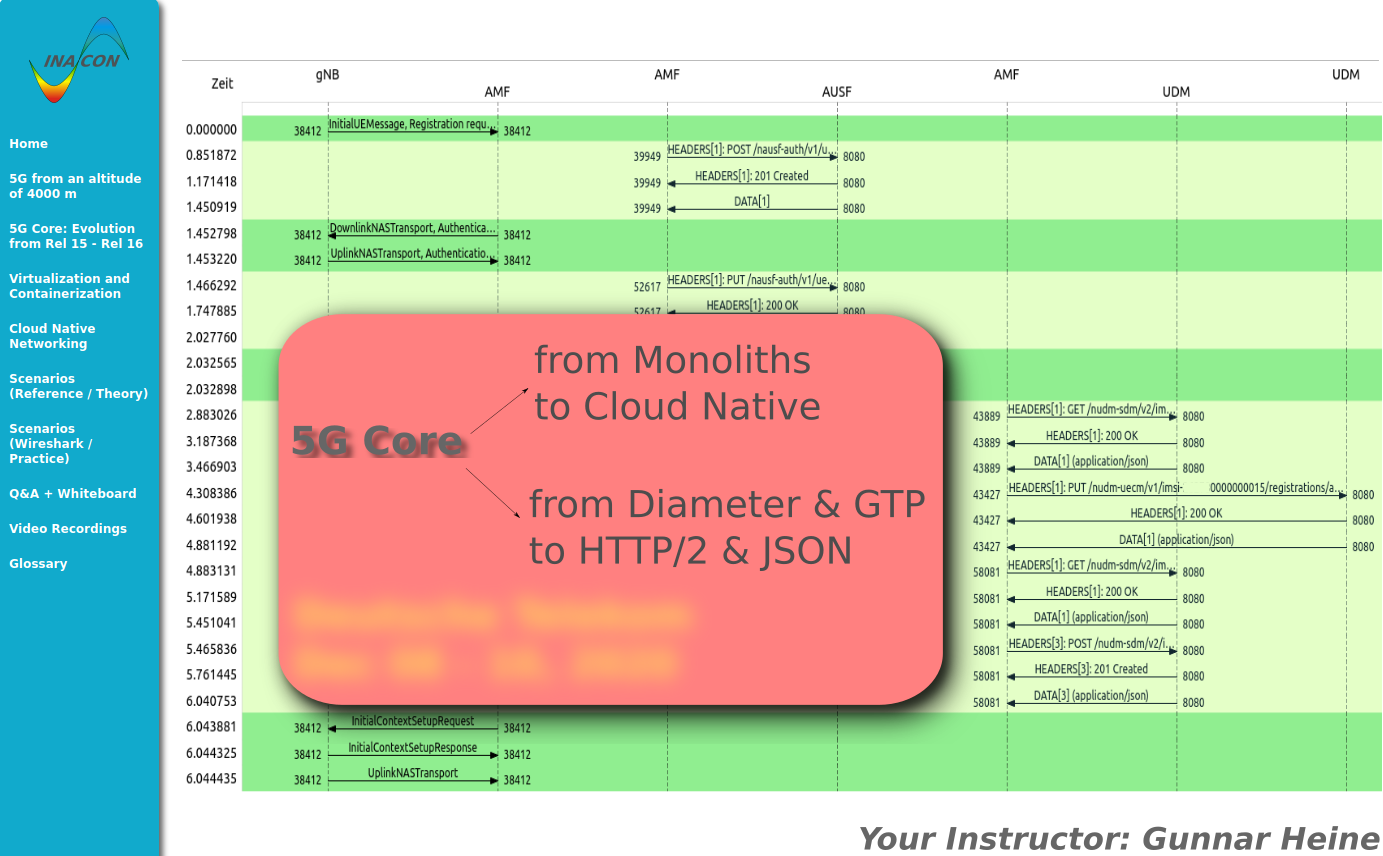
First of all, we need to apologize for the late announcement of this new training course about the 5G core network, that has been developed already in summer 2020 for the lossless provisioning as online training course compared to face-to-face courses. Of course and if you prefer, we can conduct this course onsite, too. If you want to learn more about our fascinating and unique new methodologies, please send an email to inacon@inacon.de and we shall be happy to provide you a short demo session.
But back to the course: The course addresses the needs of technical engineering staff who require a detailed understanding of the 5G core network, built inside Kubernetes (K8s) clusters using containers and cloud-native networking to host micro-services. We use tons of hands-on examples and exercises to depict the operation of containers and Kubernetes clusters, worker nodes and pods as infrastructure for the 5GC.
There is a detailed definition of the various new network functions inside the 5G core, e.g. AMF, SMF, UPF, NRF, SEPP, to name a few. In that respect, it is our target to make the students understand how these network functions are physically realized as micro-services inside a cloud-based environment. Of course, we also explain in detail the HTTP/2- and JSON-based communication among these network functions in a service based architecture (SBA) for both, roaming and non-roaming use cases.
The course contains two chapters with scenarios like registration or PDU-session establishment with one chapter depicting the theory and the other chapter revealing the related real-life logfiles (usually Wireshark / see image above).
Some of your questions that will be answered during this course:
- How are network elements and network functions broken down into micro-services?
- Why does the 5GC require the use of HTTP/2 and JSON for the communication among the micro-services / network functions?
- What is HTTP/3 and does it currently play any role in the context of 5G?
- What is the meaning of PRINS and OAUTH2.0 and how does it enable secure communication among 5G core networks in case of roaming?
- Which network function in the 5GC is responsible for which tasks?
- How is the 5GC physically realized in a Kubernetes environment?
- Which constraints apply for the size of Kubernetes cluster in terms of No of pods, nodes etc.?
- Why does 3GPP endorse new authentication options like EAP-TLS?
- How does a UE register to the 5GC and which network functions are involved?
- How does a UE obtain its IP-address(es) from the network and which network functions are involved?
- How does Inter-RAT mobility work between LTE and NR, esp. with N26-interface deployed?
- What are the differences and specifics of HW- and OS-virtualization? What are the differences and specifics of containers and virtual machines?
- How precisely does mobile edge computing work and which requirements does it impose on the 5GC?
- What happens if the UE needs to register to a specific network slice?
- Why does 3GPP introduce the 5G-AKA authentication procedure and what are differences compared to EPS-AKA?
- How can we trace the signaling among different containers in a cloud?
- How does Kubernetes achieve load balancing among different pods?
Please check here for a detailed view on the content.
Please send an eMail to inacon@inacon.de if you like further information.
Jan 2020: New Training Course
5G NSA: RAN & New Radio in first commercial networks
The course goes pretty deep into both, 5G PHY and NSA specifics and you must possess basic knowledge of 5G and detailed knowledge of LTE PHY and RRC.
Some of your questions that will be answered during this course:
- How precisely does option 3x operate and how does it differ from other options?
- How does cell search work with 5G? How is it different between stand-alone and non-stand-alone?
- Which bands 4G / 5G are combined with MR-DC in different parts of the world?
- To which degree can beamforming mitigate the additional attenuation from operation in the 3.X GHz bands or even in millimeter wave bands?
- How do active antennas look like and operate for 5G operation?
- Which number of antenna ports provides the optimum performance under which conditions?
- What is vertical beamforming and when does it make sense to deploy it?
- Under which conditions can Inter-Modulation-Distortion (IMD) jeopardize NSA-operation and which options exist to mitigate these RF-related problems?
- When will the UE display the 5G icon to the user?
- What are the implications of deploying different subcarrier spacings with NR?
- Which additional problems arise from TDD-operation in cellular vs FDD-operation?
- What is the meaning of the GSCN and the SS-block pattern?
- How can NR deploy beam-centric operation already in idle mode?
- Why is there no more DC-subcarrier?
- What are self-contained TTI and dynamic TTI?
- Which reference signals does NR use and how is this different from 4G?
- Which performance gain to expect from mMIMO with more than 8 antenna ports on the network side?
- How does uplink beamforming operate?
- What are the NR- and MR-DC - specific contents of a UE-Radio-Access-Capability Message?
- How is a 5G cell added to an existing RRC-connection?
Please check here for a detailed view on the content.
Please send an eMail to inacon@inacon.de if you like further information.
Jun, 2018: New Training Course
"LTE-M / Cat-M1/M2 - Design Details & System Engineering
 In 2017, the whole market was excited about NB-IoT but this year, many players in Europe and North America have identified a lot of potential in LTE-M, many times also referred to as Cat-M, operating in just 1.08 MHz bandwidth. Having been introduced with Rel. 13, Cat-M has been underestimated for a long time in both aspects: complexity and market potential.
Finally, INACON is offering a bit-level course for everybody who requires really detailed knowledge about this technology, which is so much similar to plain LTE with all these tiny little differences.
Please check here for a detailed view on the content.
Please send an eMail to inacon@inacon.de if you like further information.
INACON announces the availability of an exciting new online / video training about 5G-technology:
5G made simple
 This course is structured into three chapters and enables a self-paced technology training experience for everybody who requires a fast yet comprehensive introduction into 5G and the technologies behind.
- Overview of 5G
- Technology Enables for 5G
- Network Architecture and Protocol Stack of 5G
Please check out the following demo sections on YouTube:

For more details and ordering information please send an eMail to inacon@inacon.de
Sep, 2017: New Training Course
5G - On the Way to the next Generation of Mobile Networking
 After 3GPP accomplished a major milestone end of August 2017, we are happy to present an updated version of our first course on 5G. Focus of the new course is on the following areas:
- What is the migration path towards 5G? In that respect, how does NSA work?
- What to expect in the PHY? Here we namely present the numerology of filtered OFDMA as it will be used in 5G. However, quite some focus is also on the new coding technologies LDPC and polar coding.
- To which degree will virtualization affect the network architecture in 5G? How can the so called gNB be split into a virtualized and a non-virtualized part and which role does eCPRI play in that matter?
- How can the envisaged extremely low latencies be realized with 5G?
Please check here for a detailed view on the content.
Please send an eMail to inacon@inacon.de if you like further information.
Mar, 2017: New Training Course
LRWPANs based on IEEE 802.15.4
 INACON releases this exciting new course to further complete our series on IoT technologies. Starting out with a general presentation of LRWPANs and their market, the course presents details of ZigBee and Thread as two typical LRWPAN-technologies.
Special focus is put on the presentation of the PHY and MAC-layers of IEEE 802.15.4 and a description of the upper layers, specifically on ZigBee
Please check here for a detailed view on the content.
Please send an eMail to inacon@inacon.de if you like further information.
Jul, 2016: New Training Course
NB-IoT -
Design Details & System Engineering
 INACON is happy to announce the soon availability of our system engineering level course on NB-IoT. This course is targeted at everybody who requires really deep understanding of NB-IoT and its capabilities and liabilities.
After a comparison among the different longrange IoT-technologies, the course dives deep into the RF, PHY and higher layers of NB-IoT and answers several questions.
Please check here for a detailed view on the content.
Please send an eMail to inacon@inacon.de if you like further information.
Apr, 2016: New Training Course
LTE Advanced - Rel. 12 & Rel. 13 specific Enhancements
 We are pleased to introduce our new training course
LTE Advanced - Rel. 12 & Rel. 13 specific Enhancements
This course addresses the needs of technical engineering staff who work on the design, test, integration and validation of LTE-Advanced equipment esp. on the UE-side.
The course has been designed to meet specifically the requirements of chipset verification, integration and testing. The course starts out with a description of the most important trends and visions, in the year 2016, namely the upcoming IoT, the increasing level of network virtualization, the migration towards 5G, the engagement between LTE and WiFi through different options like LTE-U, LAA or LWA and, last but not least, the ever increasing level of scope of carrier aggregation.
Following this chapter, the course reviews the most relevant details of LTE from Rel. 8 up to Rel 11. Note that our trainer will tailor the level of detail and the time spent on this chapter depending on the existing knowledge of the course participants. The following two chapters are dedicated to a detailed description of the updates to LTE-A with Rel 12 and Rel 13. In these chapters, we cover the different levels of carrier aggregation enhancements with Rel 12 and 13, e.g. UL-CA, combined FDD/TDD-CA and the related constraints and practical implementation challenges. In this part of the course we also introduce dual connectivity and its specifics for the UE and for the network side as a new way to do intersite carrier aggregation.
With Rel. 12, there is an exciting new market for 3GPP which is public safety, covered by the ProSe-, D2D- and sidelink- related parts of the specifications. We deal with this fascinating new technology and some of its specifics in this part of the course. Following a detailed analysis of various other enhancements like using 256-QAM modulation, the focus of the course changes to MTC and the IoT. We depict, which approach is taken by 3GPP to suit the needs of the IoT in a 3GPP-environment and point to alternative approaches like SigFox and Lora. The most important topics with respect to 3GPP, dealt with in detail are eDRX, PSM, SIM-less operation and the architecture and radio interface of the NB-IOT. Last but not least, the course focus is on LTE-U, LAA and LWA and depicts the pros and cons as well as the specifics of these three different approaches to combine LTE-A and WiFi.
Please send an eMail to inacon@inacon.de if you like further information.
Dec 23, 2015: New Training Course
"Network Virtualization: Details, Theory & Practice"
 We are pleased to introduce our new training course
"Network Virtualization: Details, Theory & Practice".
This course addresses the needs of technical engineering staff within telecom carriers and equipment and software vendors who are involved in the design, setup and testing of virtualized telecom network equipment and software.
Special focus of the course is on the ETSI ISG-based reference architecture. To emphasize the meaning of SDN for NFV, we establish during the course a live virtual network using Mininet and demonstrate basic SDN and OpenFlow operation with Wireshark.
From there the course pinpoints to cloud computing and the related business models like IaaS, SaaS, PaaS and makes the student familiar with the ideas of NFVIaaS, VNFaaS and VNFPaaS.
The following parts of the course focus on the detailed description of the ETSI-reference architecture and make the students familiar with the different terms like MANO, NFVI and VNF, VIM VNFM and WIM.
We explain in detail the configuration and setup of VNFs consisting of one or more VNFCs using differently configured virtual links.
The next part of the course is dedicated to MANO-descriptors like the VNFD, VLD, NFPD and VNFFGD that are crucial for the configuration, operation and interworking of the virtualized network equipment. We depict examples and explain their meaning and potential errors step by tstep which is so important for testing commissioning.
The next lecture deals with the optimization and acceleration of virtualized environments and describes which means exist for that optimization like localized memory (NUMA) and multiple core operation. This part also deals with potential performance killers like interrupts and how to mitigate their impact.
Did we make you curious?
Then please click here to obtain more details about this course or contact us.
Jun 18, 2015: New Training Course
"eMBMS from A-Z"
 We are pleased to introduce our new training course
"eMBMS from A-Z".
This course addresses the needs of engineers and technicians, who need to get familiar with eMBMS. The course provides an overview of the important video broadcasting technologies, such as Digital Video Broadcasting (DVB) or Digital Multimedia Broadcast (DMB) and compares them to eMBMS.
Having the general broadcasting overview in mind, the subject will be expanded with the specific architecture of MBMS for both UTRAN and eUTRAN. We will explain the reference points, new network entities, operation modes and important session scenarios.
Clear focus is on eMBMS with the description of new channels like MCCH or MTCH.
Another important focus is the eMBMS operation within E-UTRAN and EPC. Protocol extensions like SYNC and new network entities like the BM-SC and the MBMS-GW will be dealt with in detail.
The MBMS user services, such as service subscription, data delivery, charging, security and QoS, which use the bearer services explained before, will be presented in detail. Some important service scenarios will intensify the understanding of eMBMS services.
Did we make you curious?
Then please click here to obtain more details about this course or contact us.
Milpitas, CA, Apr 2015:
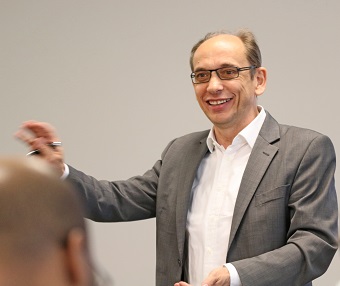
INACON proudly announces the successful delivery of two new courses to selected VIP-customers at the CETECOM-facilities in Milpitas / Silicon Valley. The two courses covering tailored aspects of
LTE-A Rel 12 and Gigabit-WiFi 802.11ac/ad were held back to back last week onsite with tremendously good feedback from the VIP-customers which came together from all over North America.

Gunnar himself was the author and the trainer of the courses and enjoyed the time amongst the very engaged audience.
We like to thank the CETECOM team for their great job in hosting the event and sponsoring the social event. We also like to express our appreciation to all the customers asking this incredible amount of questions.
Feb 20, 2015: New Training Course
"From IEEE 802.11n to 802.11ac and ad"
 We are pleased to introduce our new training course
"From IEEE 802.11n to 802.11ac and ad".
This course focus is on the VHT-related enhancements which the IEEE specified in the 802.11ac extension of the WLAN / WiFi standard series. However, the course also explains the specifics of 802.11 ad and the differences between these two amendments. Starting out with a primer on "before ac", the course initially focuses on 802.11 operation with respect to channel access and resource sharing. Namely the different channel access functions DCF, PCF, EDCA and HCCA are dealt with in detail and their differences and specifics are pointed out. During this part, the course also repeats the most important other characteristics of the OFDM-PHY and the MAC-layer. This includes a detailed consideration as to how QoS may be enabled in 802.11. The following chapter starts with an overview of the different groups of features which are added by the "ac"-extension of the standard. This chapter concludes with the "live"-calculation of the ac-related performance figures under different circumstances (e.g. modulation scheme, channelization). After this, the course focuses on the description and discussion of smart antenna techniques, namely SU-MIMO (up to 8 streams), MU-MIMO, and beamforming with ECFB as defined for 802.11ac. The students will learn without needing any mathematical formulas, how these techniques work and how they are applied in 802.11ac.
Questions like:
- How does 802.11ac differ from 802.11n? Which features are inherited from 802.11n?
- How does WiFi support the distinction of different QoS-requirements?
- What are the various 802.11ac-related enhancements? And how does 802.11ac differ from 802.11ad?
- How shall session switching operate between legacy WiFi, 802.11ac and 802.11ad?
- Why does 802.11ac not support "greenfield" PPDU?
- How does CCA (Clear Channel Assessment) operate in 802.11ac?
- When is 256-QAM feasibly used in 802.11ac?
- How does the improved RTS/CTS-operation work in 802.11ac?
- What are the consequences of 802.11ad operating at 60 GHz?
- How does beam steering work in 802.11ad?
- What is the relationship between WiGig 1.2 and 802.11ad?
- How does MU-MIMO work in 802.11ac?
- How do WPA and 802.1X improve the WiFi-security?
- Which additional gain is provided by EAP?
- How do different EAP-procedures like EAP-TLS or EAP-AKA work?
- How exactly do A-MPDU and A-MPDU aggregation work and how do they differ from each other?
will be answered during this course.
Did we make you curious?
Then please click here to obtain more details about this course or contact us.
Dec 23, 2014: New Training Course
"Car-2-X Communication from A-Z"
 We are pleased to introduce our new training course
"Car-2-X Communication from A-Z".
This course has been tailored as interface information between the car industry on one hand and the communication industry on the other hand. Starting out with a description of the various Car 2 X communication types and peers, the course makes the students familiar with the feasibility and constraints of the different wireless communication technologies, namely IEEE 802.11, Bluetooth and 3GPP-based radio.
In that respect, Car 2 X has specific requirements when it comes e.g. to reliability, security and connection setup times. The course concludes with the description of hot topics like eCall and SOTIS and depicts what the future may yield for all involved parties.
Did we make you curious?
Then please click here to obtain more details about this course or contact us.
Oct 22, 2014: New Training Course
"LTE Advanced - Rel.11 specific Enhancements"
 We are pleased to introduce our new training course
"LTE Advanced - Rel.11 specific Enhancements".
This course addresses the needs of technical engineering staff who work on the design, test, integration and validation of LTE-Advanced equipment esp. UE-side. The course has been designed to meet specifically the requirements of UE-testers for chipset verification, integration and testing.
Did we make you curious?
Then please click here to obtain more details about this course or contact us.
Aug 04, 2014: Free Test Run of our New Course
"LTE-A to LTE-C Design Details & System Engineering" in North America
 INACON announces a free test run of our new course
"LTE-A to LTE-C Design Details & System Engineering".
in North America, to be hosted by our partner CETECOM Inc. in Milpitas, California on September 24+25, 2014.
Top experts from within the industry are invited to join us and receive detailed technical information about LTE-Advanced in Rel. 10 up to Rel. 14.
You may use the following link to register or ask more questions here.
Apr 09, 2014: New Training Course
"VoLTE from A-Z"
 We are pleased to introduce our new training course
"VoLTE from A-Z".
The course describes the voice over LTE options with special focus on IMS-based options and on SRVCC with SIP and SDP. We will start with an overview of the IMS related architecture with special focus on the LTE Access network and 3GPP interworking with other RATs. The course continues with the bearer concept and QoS architecture in LTE, discussing the procedures for default and dedicated bearer setup incl. interaction with the policy functions (PCRFs). Another focus is the detailed and practical analysis of the signaling and media stream protocols, in particular SIP and SDP, Diameter for policing and RTP / RTCP for voice and other media transport in LTE. Obviously, we will discuss in detail all relevant alternatives for voice over LTE with and without IMS support, such as SRVCC and CSFB. Hands-on analysis and description of scenarios and message logs for SRVCC and CS Fallback completes the course.
Questions like:
- Why is IMS becoming an important function for LTE deployments supporting roaming voice subscribers?
- What are the main controlling entities for voice support in an IMS / LTE system environment?
- How are voice bearers identified and handled distinct from other services?
- How are sessions initiated and controlled, what is meant by a transaction, a SIP call and a SIP dialog?
- How are SIP transactions and dialogs identified? What are the most important header fields and their purpose?
- Where and for what purpose is Diameter protocol being used in a network deploying voice over LTE?
- Which mandatory codec types have to be supported for the media stream?
- How does a softswitch work and what are its main components and signaling interfaces?
- What is CS Fallback and when and where is it applicable? How is CSFB signaled / triggered?
- What is SRVCC and when and where is that applicable? How is this distinct from CSFB?
- How is SMS handled in an LTE voice environment and what are the alternatives for SMS here?
will be answered during this course.
Did we make you curious?
Then please click here to obtain more details about this course or contact us.
Dec 20, 2013: New Training Course
"LTE-A to LTE-C Design Details & System Engineering"
 We are pleased to introduce our new training course
"LTE-A to LTE-C Design Details & System Engineering".
This course addresses the needs of technical engineering staff who work on the design, test, integration and validation of LTE-Advanced equipment, both network and UE-side. The course provides a thorough review of LTE-releases 8 and 9 before jumping deep into everything you need to understand about design details and system engineering in LTE-Advanced. Starting out with the details of carrier aggregation, the following chapters are dedicated to all LTE-Advanced features like the new MIMO-modes, HetNet-operation, the integration and operation of relay nodes, the improvements with eICIC and feICIC and a detailed description of the new features with Rel 12 and their realization like for instance "new carrier type", MTC and D2D.
Questions like:
- Which carrier aggregation scenarios have been defined in Rel 10, 11 and 12?
- Will SRVCC in the direction from LTE to 2G / 3G become applicable and how does this compare to CSFB?
- How do remote radio heads (RRH) compare to WiFi-hotspots?
- What is the basic difference between WiFi offloading with IFOM and SIPTO?
- What is an EPDCCH and how does it operate?
- How does CoMP operate in downlink and uplink direction and which advantages does it yield for HetNet operation?
- Which new features will be coming with Rel 12 like for instance D2D or MTC?
- Which new transmission modes are introduced with LTE-Advanced and which new options do they offer for the new MIMO-modes?
- What is the relationship between SRVCC and IMS Service Centralization and Continuity (SCC)?
- Do we need to prepare for ZUC as new stream cipher?
- How does the UE convey its carrier aggregation related capabilities to the network?
- Which new procedures does feICIC yield compared to previous versions of this feature packet?
- Why is there a new PUCCH-format 3 and what does it offer compared to previously defined PUCCH-formats?
will be answered during this course.
Did we make you curious?
Then please click here to obtain more details about this course or contact us.
Apr 12, 2013: New Training Course "Bluetooth Operation, Procedures and Testing - Reloaded"
 We are pleased to introduce our new training course
"Bluetooth Operation, Procedures and Testing - Reloaded".
We are pleased to introduce our new training course "Bluetooth Operation, Procedures and Testing - Reloaded". This unique course first explains the origins of Bluetooth and the business perspective of Bluetooth. The student obtains a detailed knowledge about the various sources and administratives for a successful Bluetooth implementation. The next part of the course is dedicated to the core specification of Bluetooth and a detailed consideration of the various parts of the Bluetooth protocol stack, including functions like pairing, security or power control and energy saving modes (e.g. BLE). Special focus is given to a detailed understanding of the lower layers of the Bluetooth protocol stack (Baseband, Link Controller, Link Manager) and an understanding of the signal processing chain within the Baseband.
Questions like:
- How does EDR 2.0 Mbit/s and 3 Mbit/s work?
- What is new with Bluetooth version 3.0 and 4.0?
- What are the functions of the various layers of the Bluetooth Protocol Stack and which layers do I need to implement my feature set?
- How can I test my Bluetooth implementation and what will be tested?
will be answered during this course.
Did we make you curious?
Then please click here to obtain more details about this course or contact us.
Feb 06, 2013: New Training Course "Android and Mobile Network Technologies"
 We are pleased to introduce our new training course
"Android and Mobile Network Technologies".
This new course will present mobile network technologies from the perspective of Android terminal equipment, covering legacy voice services with GSM and its evolution through UMTS / HSPA up to most recent technologies, such as LTE. The student will become familiar with the 3GPP specific terminologies for the radio, core and service delivery domains. The main focus is on the architectural view from both the user equipment and the network side, mapping 3GPP signaling and protocol stack and interface entities to ANDROID functions, libraries and interfaces. Although this is not an ANDROID OS specific programming training, we will at least provide an overview on the programming environment and packages required to build custom communication applications. Finally, the course will also cover service specific requirements for ANDROID based communication systems, such as roaming considerations between different access networks, realtime requirements for e.g. combined video and voice service deliveries and integration of provider specific functionalities.
Questions like:
- What are the main differences in the baseband modems in terms of access technology between GSM, UMTS, LTE and WiFI?
- How does the communication and service delivery work towards a Mobile Network?
- How are ANDROID communication functions - such as voice and non-voice features mapped to the network transport protocols and functions?
- What is Smartphone Architecture as viewed from 3GPP on one side and from the ANDROID perspective on the other side?
- Which are the main communication protocols that are supported and for which purpose?
- What are the main components and libraries an ANDROID system is composed of?
- Which are the most important tools used to build an ANDROID system?
- Which are network services on an ANDROID system, that may require special attention and why?
will be answered during this course.
Did we make you curious?
Then please click here to obtain more details about this course or contact us.
Dec 14, 2012: New Training Course "How to Manage IPv6 Deployments"
 We are pleased to introduce our new training course
"How to Manage IPv6 Deployments".
This course focusses on identification of the most critical IPv6 deployment issues and will provide some guidance for smooth transition from IPv4 to Ipv6.We will identify different problem areas, e.g. around dual stack host implementations, OS dependencies with migration strategies, incompatibilities with DNS / DHCP requests and addressing schemes as well as different supported feature sets at network nodes (gateways, routers and servers). In order to understand all possibilities and procedures, we will start with a discussion of all IP header field elements, identify all parts that have been inherited from IPv4, clarify the terminology and explain all the new header elements, their purpose and intended usage. The IP header structure will be completed with the detailed consideration of the new concept of Extension Headers in IPv6 and the purpose and usage of each of the options. We will then thoroughly discuss the address structure of IPv6 with the formats of Unicast, Multicast and Anycast addresses and what the options are to obtain a valid IP address.
Questions like:
- How does the IPv6 protocol header differ from IPv4?
- Which elements are still used in IPv6 and what is the reason for changes in terminology?
- What are Extension Headers, which information do they convey and how and when are these extensions being used in IPv6?
- What is the structure of an IPv6 address and which parts are being used for public routing and how?
- What are the changes in the support protocols such as ICMP and what happened to ARP in an IPv6 environment?
- What is a Link-Local Address and how is that address obtained / generated?
will be answered during this course.
Did we make you curious?
Then please click here to obtain more details about this course or contact us.
Oct 31, 2012:
We proudly like to introduce our new Webinar
"GigaBit WiFi: IEEE 802.11ac and ad in 3 Hours"
 This webinar provides a fast track to the concepts and technology of the latest extensions of the WiFi-family, which are 802.11ac and 802.11ad.
Questions like:
- Which changes do 802.11ac and 802.11ad provide and how do they compare to e.g. 802.11n?
- What is the current status of the standardization of 802.11ac and 802.11ad?
- How do both technologies differ from each other?
- Which devices are already there and when to expect a wide availability of devices, supporting 802.11ac and/or 802.11ad?
- Which technical enhancements are used to provide the better performance of 802.11ac and 802.11ad?
- Which of the new features are mandatory or optional for AP and STA according to th already there and when to expect a wide availability of devices, supporting 802.11ac and/or 802.11ad?
- Which technical enhancements are used to provide the better performance of 802.11ac and 802.11ad?
- Which of the new features are mandatory or optional for AP and STA according to the current status of the standardization?
will be addressed in this webinar.
Did we make you curious?
Then please click here to obtain more details about this webinar, or contact us.
Oct 01, 2012: INACON to present at the "Automotive Infotainment" Congress in Munich, Oct 17 and 18

Our CEO, Mr Gunnar Heine, has been invited to talk during that congress about LTE and its potential issues focussing on the use within the automotive environment. Special attention will be put on topics like frequency availability, voice as application and coverage.
Did we make you curious?
Then please click here to obtain more details about this Congress.
Jul 19, 2012: Consultancy: LTE Drivetests Analysis for Network Operators"
|  |
|

Jun 26, 2012: New Training Course "IMS and SIP Signaling – VoLTE"
 We are pleased to introduce our new training course
"IMS and SIP Signaling – VoLTE".
We start with an overview on the IMS related architecture with special focus on the LTE Access network and 3GPP interworking with other RATs. We then introduce the bearer concept and QoS architecture in LTE / SAE discussing the signaling for default and dedicated bearer setup, e.g. IMS triggered with the interaction with the policy functions (PCRFs). A central part will be an introduction to the signaling and media stream protocols, such as SIP / SDP, Diameter for policing and RTP / RTCP and their applicability for voice and other media transport in LTE. We then discuss in detail the alternatives for voice over LTE – with and without IMS support, such as SRVCC, CS Fallback and also quickly review other solutions such as VoLGA etc. Related scenarios and different use case for SRVCC and CS Fallback – including SMS transmission – will then conclude the course.
Questions like:
- Why is IMS becoming an important function for LTE deployments supporting roaming voice subscribers?
- What are the main controlling entities for voice support in an IMS / LTE system environment?
- How are voice bearers identified and handled distinct from other services?
- How are sessions initiated and controlled, what is meant by a transaction, a SIP call and a SIP dialog?
- How are SIP transactions and dialogs identified? What are the most important header fields and their purpose?
- Where and for what purpose is Diameter protocol being used in a network deploying voice over LTE?
will be answered during this course.
Did we make you curious?
Then please click here to obtain more details about this course or contact us.
May 14, 2012: New Training Course "DIAMETER and Charging in LTE/IMS"
 We are pleased to introduce our new training course
"DIAMETER and Charging in LTE/IMS".
This course describes in detail structure and application cases of the Diameter protocol. An important part of the course will cover the policy control architecture and the alternatives with the logical entities PCEF and PCRF in a distributed environment as well as Diameter signaling routing and the use and purpose of Diameter Routing Agents (DRA's). We will then review the various applications and interfaces developed by 3GPP for Diameter and will particularly focus on Diameter in the IMS and EPC environment for Authorization, Authentication and the usage in the security architecture. The Diameter Cx / Dx, S6, SWx and Sta interfaces will be evaluated in detailed with selected scenarios and sample log files to explain interworking with the HSS and AAA servers in 3GPP. The details of the commands and parameters of the Sh and Dh interfaces will explain the communications with application servers in the IMS environment with the access and update of profile information and access rights.
Questions like:
- What are the main differences between RADIUS protocol and its successor Diameter?
- How is the Diameter protocol structured and which applications and interfaces are supported by IETF and 3GPP?
- Which are the generic functions supported by the Diameter Base Protocol part and which services are being covered?
- What is the Diameter protocol stack in detail and which transport protocols are being used?
- How is Diameter used in the IMS environment, which functions are realized and how?
- Which commands are used on the Cx / Dx, interfaces?
- Where is Diameter used in the EPC and what are the interfaces?
will be answered during this course.
Did we make you curious?
Then please click here to obtain more details about this course or contact us.
Apr 19, 2012: New Training Course "LTE Advanced from A-Z"
 We proudly announce the availability of our new training course
"LTE Advanced from A-Z".
We are pleased to introduce our new training course "LTE Advanced from A-Z". The main focus of this course is the evolution of the LTE system towards LTE Advanced based on Release 10 and beyond (Release 11). The first sections cover specifics of the enhanced radio concepts of LTE Advanced increasing the peak and average data rates per user. Focus of the first section is carrier aggregation (CA). This includes detailed look at implementation options and the control channel design. Keywords are cross carrier scheduling, PUCCH Format 3, Carrier Indicator Field, HARQ operation, CQI and PHR reporting. The next section illustrates the enhanced MIMO concept in downlink and uplink. The modifications for PUCCH, PDCCH, PDSCH and the new reference signals (CSI-RS, DM-RS) will be discussed for both directions. One section provides an introduction to Coordinated MultiPoint transmission and reception (CoMP) which is still in the standardization process. Additional sections discuss features which help to manage future LTE networks. This includes enhanced functionality of LTE Home Base Stations (HeNB), Heterogeneous Networks (HetNet) and LTE relay nodes as well as using UE measurements to minimize drive tests (MDT). Special attention is put on features affecting the performance of UEs. For example the Almost Blank Subframe (ABS) required for enhanced Inter-Cell Interference Coordination (eICIC).
Questions like:
- What are the main improvements of LTE Advanced compared to LTE?
- How does HARQ work with carrier aggregation / enhanced MIMO?
- What is a component carrier?
- Will LTE Advanced features affect the performance of legacy UEs?
- What is Coordinated Multipoint Transmission (CoMP) and how does it work?
will be answered during this course.
Did we make you curious?
Then please click here to obtain more details about this course or contact us.
Mar 12, 2012: New Training Course "UMA/GAN from A-Z"
 We proudly announce the availability of our new training course
"UMA/GAN from A-Z".
We are pleased to introduce our new training course "UMA/GAN from A-Z". This new course addresses the needs of everybody who requires a thorough understanding of generic access operation and procedures. The course starts with an introduction into the current implementation situation of UMA/GA and it continues with a detailed discussion of WiFi and its operation as baseline for generic access. This part covers the physical layer as well as the MAC-layer and includes an overview of 802.11n and WiFi-security methods. In the next portion, the course focuses on GA-elementary procedures like GANC-discovery and registration and the GA-integrated security procedures like IKEv2, EAP-SIM and EAP-AKA. The courses concludes with a detailed description of GA-based layer 3 procedures like call setup and short message delivery. This part includes detailed handover and rove in/out procedure presentations between WiFi and GSM and WiFi and UMTS.
Questions like:
- Which network operators and which devices do support generic access?
- How can WiFi serve as bearer for GSM-/UMTS-based procedures like voice calls or short message delivery?
- What are the differences between serving, default and provisioning GANC's?
- How does a mobile phone setup an IPsec-tunnel towards a GANC?
- How does a mobile phone switch back and forth between GAN and GERAN/UTRAN, perhaps with an active voice call?
will be answered during this course.
Did we make you curious?
Then please click here to obtain more details about this course or contact us.
Oct 20, 2011: New Training Course "LTE Evolution and the Way to 5G"
 We proudly announce the availability of our new training course
"LTE Evolution and the Way to 5G".
We are glad to pre-announce the soon availability of our new course "LTE Evolution and the Way to 5G". The main focus of this 2-day course is the evolution of the LTE system from LTE to LTE-Advanced (3GPP Rel. 10 and 11) and beyond. After a recap of the key parameter of the LTE access scheme, as well as MIMO, the course lists the motivating factors to migrate towards LTE-Advanced. In addition the course presents other evolutions inside the system, which include functions of SON, interworking challenges with other RATs and finally an outlook towards 5G.
Questions like:
- Can HSPA+ ever be considered as a 4G technology?
- What are the main improvements of LTE-Advanced compared to LTE?
- How does LTE-Advanced meet or even exceed the ITU 4G requirements?
- What are the business drivers of SON and where can SON help?
will be answered during this course.
Did we make you curious?
Then please click here to obtain more details about this course or contact us.
Jul 18, 2011: New Training Course "IMS from A-Z - Reloaded"
 We proudly announce the availability of our new training course
"IMS from A-Z - Reloaded".
We are pleased to introduce our updated training course "IMS from A-Z - Reloaded". This course addresses the needs of everybody who needs to understand the technology and services of the IMS. New sections focus on voice over LTE functionality utilizing an IMS domain and the reasoning for this architecture according to 3GPP Rel. 8. We will also provide an actual deployment status overview for the different rollouts in Europe and North America. The course concludes with the presentation of a real-life implementation of an IMS.
Questions like:
- Why is IMS becoming an important complement for mobile operator's LTE deployments?
- What is the deployment status in Europe and North America in combination with LTE?
- Where is LTE mobility an issue vs static LTE rollouts (settop boxes / DSL replacement and complement)?
- What are typical IMS-specific applications and services like "See what I see" and how do they work?
- What are the functions of the different network nodes inside the IMS?
- What are the differences between different SIP-server types like proxy, B2BUA and SBC?
- How do real-life implementations of the IMS look like?
will be answered during this course.
Did we make you curious?
Then please click here to obtain more details about this course or contact us.
Dec 13, 2010: New training course "From LTE to LTE-Advanced"
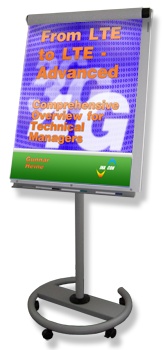 We proudly like to announce our new training course
"From LTE to LTE-Advanced".
This course addresses the needs of technical managers, engineers and technicians who are involved in the design, consideration and development of LTE and other 3GPP cellular standards and in particular the evolution from LTE to LTE Advanced.
The course focuses on both sides, UE/Mobile as well as network. We will discuss in detail the changes and enhancements that will be introduced with LTE-Advanced, such as the increase in throughput, Spectral Efficiency, the relationship with LTE, Carrier Aggregation, Coordinated Multipoint Transmission and the use of Relay Nodes.
Questions like:
- What are the technologies behind the various specification evolutions from 2G to 4G abd what is the current status of the LTE implementations?
- How does a voice call setup work with LTE, what are the options and what are the benefits of using VoLGA or IMS?
- How does Intra- and Inter-Band Carrier Aggregation work to obtain the required system bandwidth?
will be answered during this course.
Did we make you curious? Then please click here to obtain more details about this course or contact us.
Oct 19, 2010: New training course "LTE - Interworking with WiFi"
 We are pleased to introduce our new training course
"LTE - Interworking
with WiFi".
This course addresses the needs of managers, engineers and technicians
who are involved in the design, consideration and development of
interworking implementations between LTE and other 3GPP cellular
standards on one hand and WiFi on the other hand. In that respect, the
course focuses on both sides, UE/Mobile as well as network.
Questions like:
- Why is there a need for WiFi to interwork with the EPC of 3GPP Rel. 8 and later and what are the different options for network access?
- How does a voice call setup work with WiFi, what are the options and what are the benefits of using VoLGA or IMS?
- How is authentication of the terminal being done in case of roaming through WiFi instead of using LTE access?
- Which roles may the network and the UE take on when it comes to interworking?
- How is access permission being handled in case of non trusted non 3GPP access networks?
will be answered during this course.
Did we make you curious?
Then please click here to obtain more details about this course or contact us.
Jun 14, 2010:
New eBook / Book "IEEE 802.11n - Design Details and Protocol Analysis"
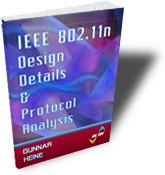 We are pleased to announce that the training course manual "IEEE 802.11n - Design Details and Protocol Analysis" in now available to all customers as ebook and also as hard copy. This ebook / book describes in detail HT-related enhancements which the IEEE specified in the 802.11n extension of the WLAN / WiFi standard series. Starting out with a primer on "before n", the course initially focuses on 802.11 operation with respect to channel access and resource sharing.
 Who should obtain the "IEEE 802.11n - Design Details and Protocol Analysis" materials?
- Test engineers who need to understand the 802.11n-features and their implications in detail.
- Designers of 802.11n-equipment who require a deep inside view of the various enhancements.
If you are interested in the "IEEE 802.11n - Design Details and Protocol Analysis"" ebook or book, please click here to view more detailed information about the ebook, and please click here for further information about the hard copy version.
May 3, 2010:
We proudly like to introduce our new Webinar "DIAMETER in 3 Hours"
 Within 3 hours "DIAMETER in 3 Hours" provides a fast track to the concepts and technology of the DIAMETER protocol as successor of RADIUS.
The webinar "DIAMETER in 3 Hours" starts out with at top-level view at the various use cases of DIAMETER with focus on 3GPP-specific applications.
Questions like:
- What is DIAMETER and how does it differ from other AAA-protocols, namely from RADIUS?
- How does DIAMETER operate within different environments like the IMS or the SAE?
- What is the structure of a DIAMETER-message?
will be addressed in this webinar.
Did we make you curious?
Then please click here to obtain more details about this webinar, or contact us.
Mar 31, 2010: German Version: Web Based Training "LTE Made Simple"
Deutsch
 Wir freuen uns bekanntzugeben, dass es unser Web Based Training "LTE Made Simple" nun auch in deutscher Sprache gibt.
Diese Web Based Training ist für diejenigen, die die Technologie und die Konzepte von LTE verstehen müssen, sowie den künftigen 4G-Standard von 3GPP.
Bitte klicken Sie hier, um die allgemeine Inhaltsbeschreibung zu lesen.
Es gibt auch eine Demo-Version, auf die Sie kostenlos zugreifen können. Sollten Sie irgendwelche Fragen haben, zögern Sie bitte nicht uns zu kontaktieren, wir werden Ihnen gerne behilflich sein!
Haben wir Ihr Interesse geweckt?
Der einfachste Weg dieses Web Based Training zu bestellen ist über unseren Online-Shop.
English
We are pleased to announce that our Web Based Training "LTE Made Simple" is now also available in German language.
This Web Based Training addresses the needs of everybody who needs to understand the technology and concepts of LTE as the future 4G standard of 3GPP.
To read the general content description, please click here.
There is also a demo version available to be accessed free of charge. In case you had any questions, please don�t hesitate to contact us, we�ll be happy to assist you!
Are you interested?
The easiest way to order this Web Based Training is through our online shop.
Search:
Know already our Webinars?
We are proud to introduce the first INACON-Webinars:
- Evolved EDGE in 3 Hours
- DIAMETER in 3 Hours
- GPRS & EGPRS in 3 Hours
- GSM in 3 Hours
- HSPA+ (R7 & R8) in 3 Hours
- IMS in 3 Hours
- IMT Advanced in 90 Minutes
- LTE in 3 Hours
- SAE in 3 Hours

INACON eBooks
Please have a look at our full offer